 Part 2
Part 4
Part 2
Part 4
When Fillmore was a lawyer, his initial lack of confidence led to a lack of ambition. Rather than competing with Buffalo lawyers, he started an office in an area with no competition. And his entry into politics was no different. During his first year in the New York assembly, he did almost nothing of importance. Scared of being ridiculed for not knowing anything, he focused on learning how the assembly worked as opposed to actually taking action on the Anti-Masonic cause.
Even though his first term was nothing special, he did get re-elected, and in his second term, he was much more active. His actions in the legislature, including calling for the abolition of the Masonic Order and helping to get prison abolished as a punishment for debt, would make him more influential over the Anti-Masonic Party. In 1831, he won a third term in the assembly, but by this point, it seemed that the Anti-Masonic Party had already peaked. The Democrats continued to do great, and the Anti-Masons weren't achieving much.
By the time of the 1832 election, things seemed even worse. In 17 out of 24 states, the Anti-Masons were irrelevant. Even where they did exist, they were weak and unable to get consistent results. The party was supposed to support the National Republicans, but this year, the National Republican candidate was Henry Clay, who hated and ridiculed Anti-Masons. So perhaps unsurprisingly, the Anti-Masons decided to run their own candidate, William Wirt. He got clobbered, only winning Vermont. And the Democrats got yet another large victory.
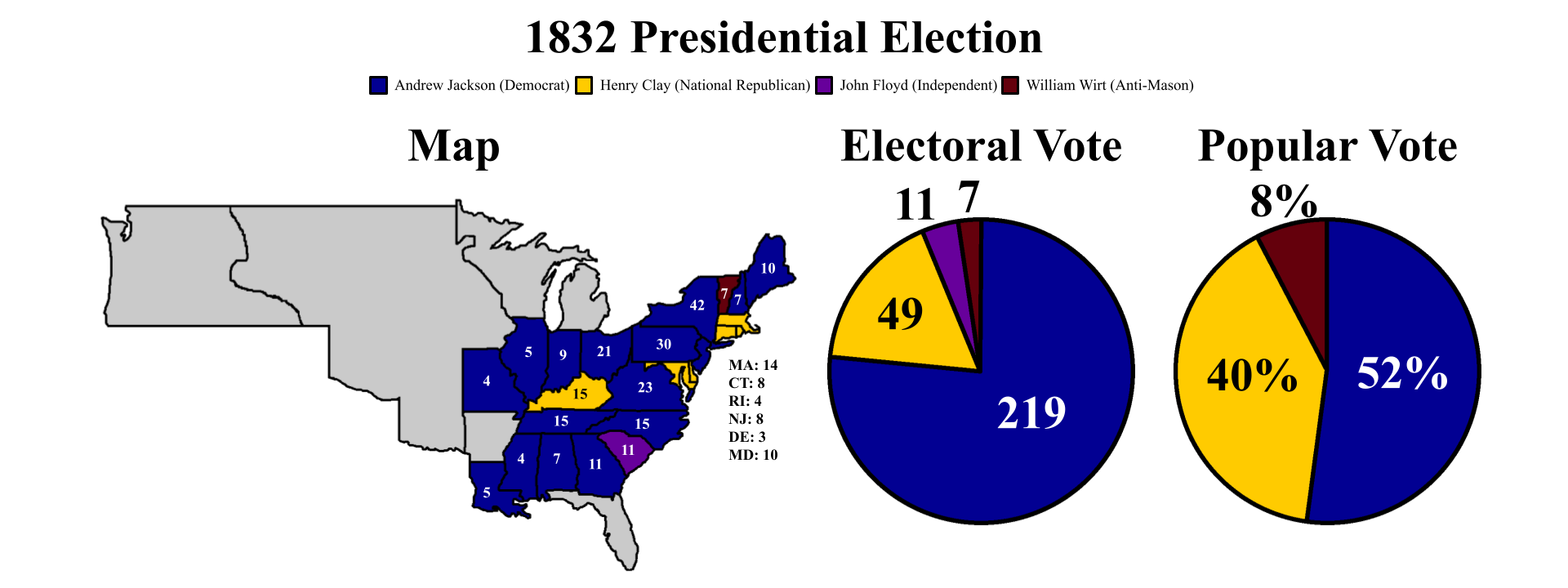
Part of the problem with Anti-Masonry is that its appeal to the average person was a lot less obvious compared to the appeal of figures like Andrew Jackson. Jackson was framed as someone who understood the common people and would fight for them. Meanwhile, it was hard to see how the destruction of a fraternal order would do much to improve the life of the average person. The 1832 election made it obvious that the Anti-Masonic Party would die, and its members would be forced to unify with the National Republicans.
Fillmore himself certainly accepted the death of his party, but ironically, 1832 saw one of his biggest victories as an Anti-Mason. Instead of remaining in the New York Assembly, he ran for the United States House of Representatives, and he won handily against his Democratic opponent.

Still, when he arrived at Washington in 1833, he knew the Anti-Masons wouldn't last much longer. He would have to help contribute to a new political party, one that could finally defeat the Democrats.
Jackson, in the beginning of his second term, began to look more vulnerable. In 1833, the economy fell into recession, and people were beginning to point fingers, with some blaming Jackson and others blaming the national bank. Fillmore wasn't sure how to feel about the national bank, disliking both sides of the debate. He hated many of the bank's activities in his home state of New York, and he hated Henry Clay, one of its biggest proponents.
But despite Fillmore's personal views on the national bank, most of Jackson's opponents supported it, and it was support of the national bank that ultimately led to the creation of the Whig Party. At the time, New York City was a Democratic stronghold. But when Jackson started his campaign against the bank, a lot of people turned on him. Soon, an election was held in New York City, and the Whig Party was finally created. The Whigs narrowly lost the race for mayor, but won control of the city council, proving that they had potential.

As the Anti-Masonic Party was crumbling, Fillmore jumped ship and joined the Whigs. Most other Anti-Masons and National Republicans would do the same, deserting their parties to unify under the Whigs. Though the party was relatively new, it did manage to get some successes, with Whigs winning gubernatorial elections in Connecticut, Massachusetts, and Indiana in 1834. Unfortunately for Fillmore, they lost to the Democrats in New York, but it was still clear that the Whigs had the potential to challenge the Democrats. They began to plan for the presidential election of 1836.
But the new party was very diverse, and its members weren't united by much other than opposing the Democrats and Andrew Jackson. This made it impossible to choose a nominee that would satisfy everyone. Generally speaking, Northerners wanted William Henry Harrison, whereas Southerners wanted Hugh Lawson White. Henry Clay and Daniel Webster also had a lot of supporters.
Fillmore's number one goal was defeating Martin Van Buren, the Democratic candidate, so he would support any candidate who could beat him. He didn't have much faith in Clay, Webster, or White, so by process of elimination, he supported Harrison. Fillmore also ensured that the Anti-Masonic Party was fully dead in his home region, finally convincing the local Anti-Masons to dissolve their organization in 1835. This helped to ensure opponents to the Democrats were all united under the Whig Party.

In the end, the Whigs were unable to unite around a single candidate. Due to the party being so new, there was no national convention to decide the nominee. Instead, the nominee was chosen by each individual state, either by a state convention or a state legislature. Generally speaking, the North chose William Harrison whereas the South chose Hugh Lawson White.
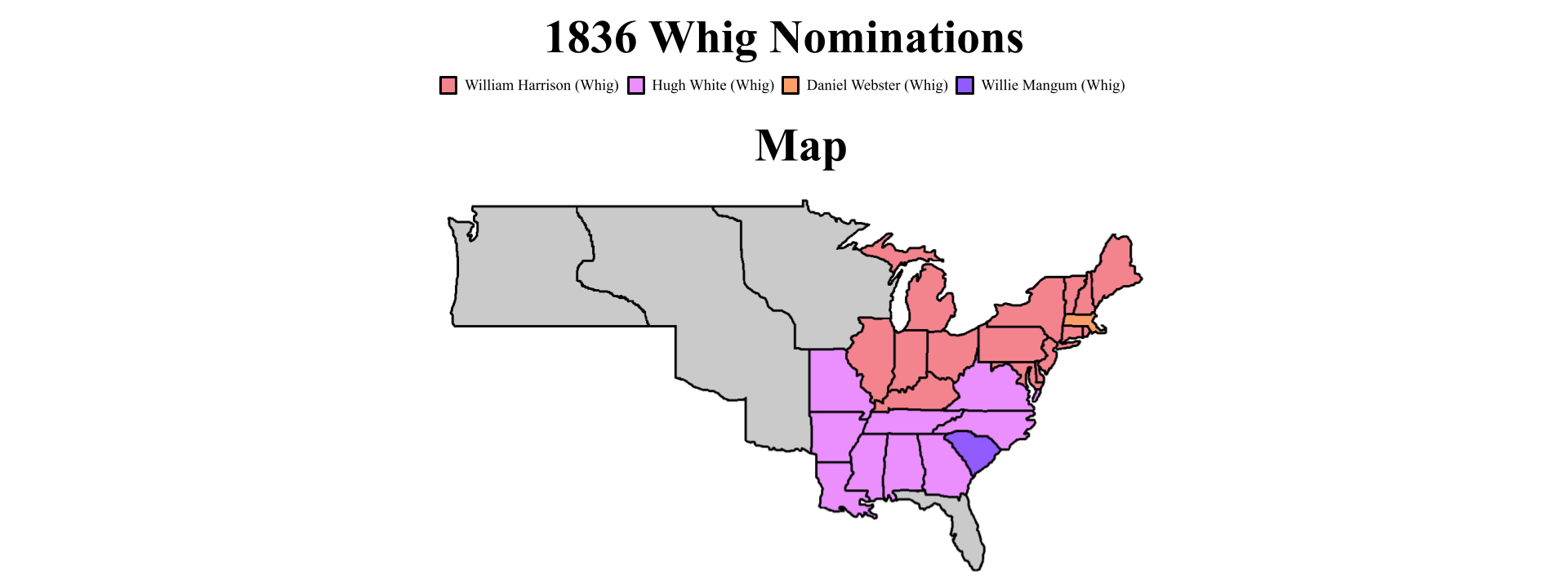
This division meant it was basically unthinkable for any Whig candidate to get an electoral college majority and win the election. Effectively, the Whig strategy was to deny the Democrats a majority in the electoral college, which would throw the race into the House of Representatives.
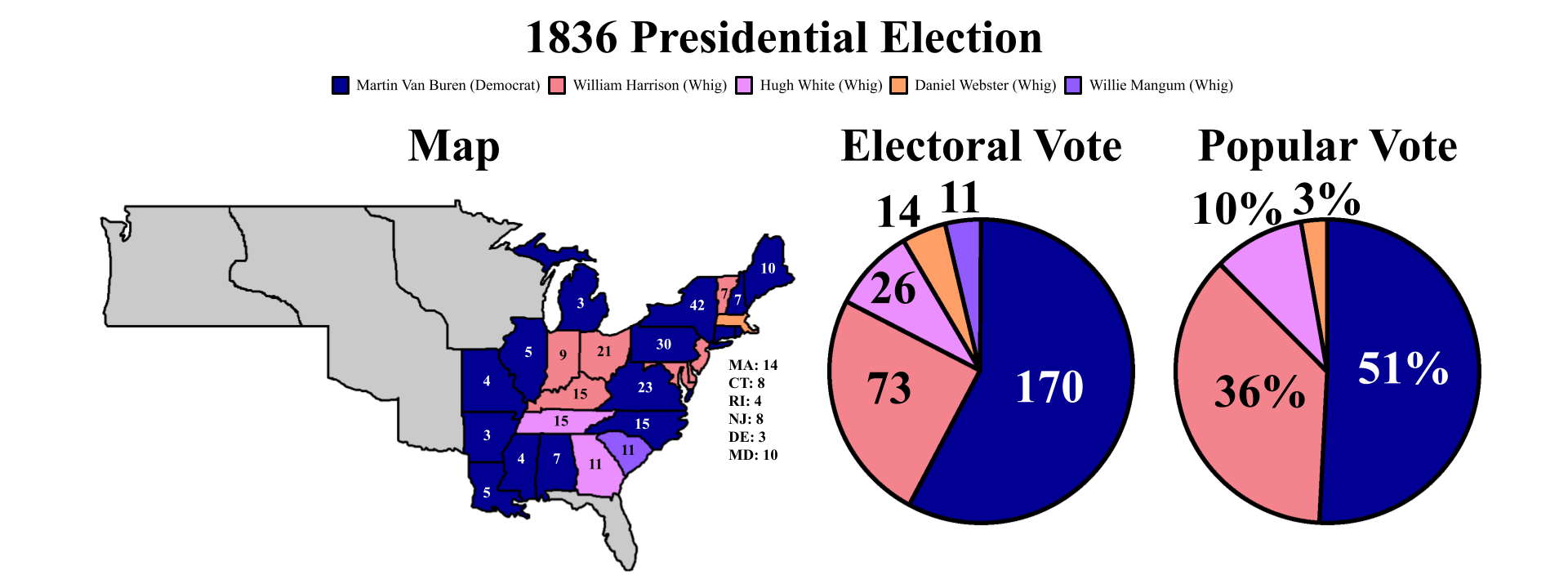
Unsurprisingly, none of the Whig candidates came even close to getting an electoral college majority. And even worse, they failed to stop the Democrats from getting one. Their biggest issue was that they lost New York, which carried 42 electoral votes, more than any other state. However, the Whigs actually performed well in Western New York, Fillmore's home region, probably due to him being such a great representative.
Though 1836 was a disappointment, there seemed to be some hope in 1837. Shortly after Jackson left office, there was a massive financial panic. It was so bad, Van Buren called a special session of congress to address the crisis. Because of this, the Whigs did well in 1837 state elections, even capturing the New York assembly.
1838 was another good year for the Whigs. In New York, Thurlow Weed supported his protege William Seward for the gubernatorial election. Fillmore opposed Seward, fearing that he would be a tough sell in Western New York. But Weed was hugely influential, and he got his way. Fillmore ultimately believed in party unity, so he campaigned heavily for Seward in Western New York despite his disappointment. In the end, Seward was able to pull off the win, and he did very well in Western New York.
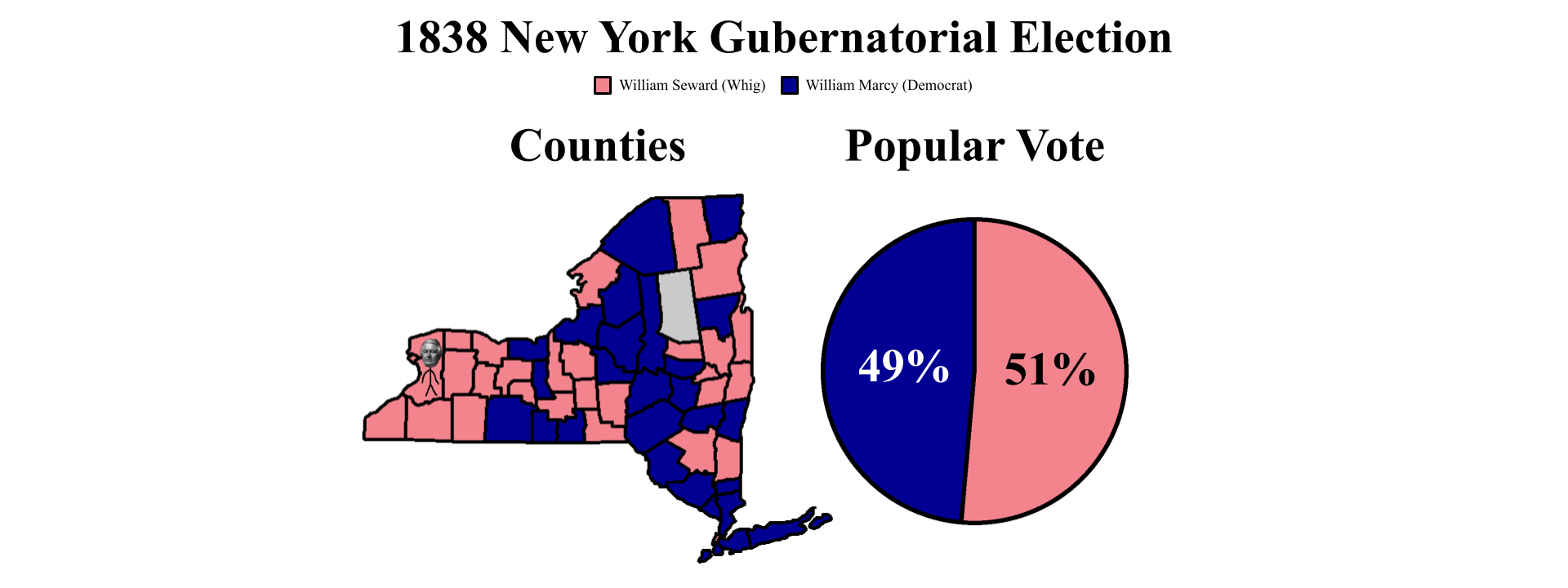
Other offices were up for grabs as well, and one of the most important was the comptroller, a position that actually had more control over the economy than the governor. Weed, who was very powerful within the Whig Party, wanted Fillmore as the comptroller, but Fillmore refused, feeling it would take up too much of his time.
But Weed was nervous and didn't trust anyone else as the comptroller. Fillmore continued to refuse, and this was the first time Fillmore refused to listen to him. Soon, some personal drama between Fillmore and Weed would lead Weed to accuse Fillmore of conspiring against him. The situation was somewhat diffused when Fillmore convinced Weed to support Bates Cook as the comptroller, but their friendship was damaged regardless.

Around this time, Fillmore was contacted by his local anti slavery society. Yeah, I know. They asked for his opinions on four political issues related to slavery:
Although Fillmore felt slavery was morally evil, he was also nervous about the issue tearing the Whigs apart, so he wasn't sure how to respond. In the end, he answered "yes" to all of these questions, but he did not provide explanations and made it clear that he may change his mind in the future. At the time, this answer was good enough for abolitionists, but eventually, slavery would become a much bigger issue for Fillmore.
Up next was the presidential election of 1840. With Van Buren being an unpopular president, the Whigs seemed to have a good chance at finally winning. There seemed to be three potential candidates: Henry Clay, Daniel Webster, and William Harrison.
Fillmore was becoming somewhat unpopular within his party due to his schism with Weed, but he felt it was important for everyone to put their differences aside to defeat the Democrats. Regardless, he still had his thoughts about who was the best candidate and who had the highest chance of winning. Although he personally liked Webster the best, he didn't think he could win. He disliked Clay and was concerned about whether a slaveholder like him could perform well in an increasingly abolitionist New York. That left William Harrison as his preferred candidate, and he theorized that Harrison would win in the electoral college.

Harrison supporters tried to convince Clay to withdraw throughout 1839, but he would not budge. Because of this, Winfield Scott emerged as a potential compromise candidate. Scott's candidacy was a problem for Clay, since Scott was very popular in Western New York, and Clay was counting on New York to win. Clay attempted to visit New York to gain support, but as he made his way through the state, he lost confidence in his chances of winning, and he finally withdrew. From there, Harrison finally emerged as the Whig nominee. All that was left was to beat Martin Van Buren.

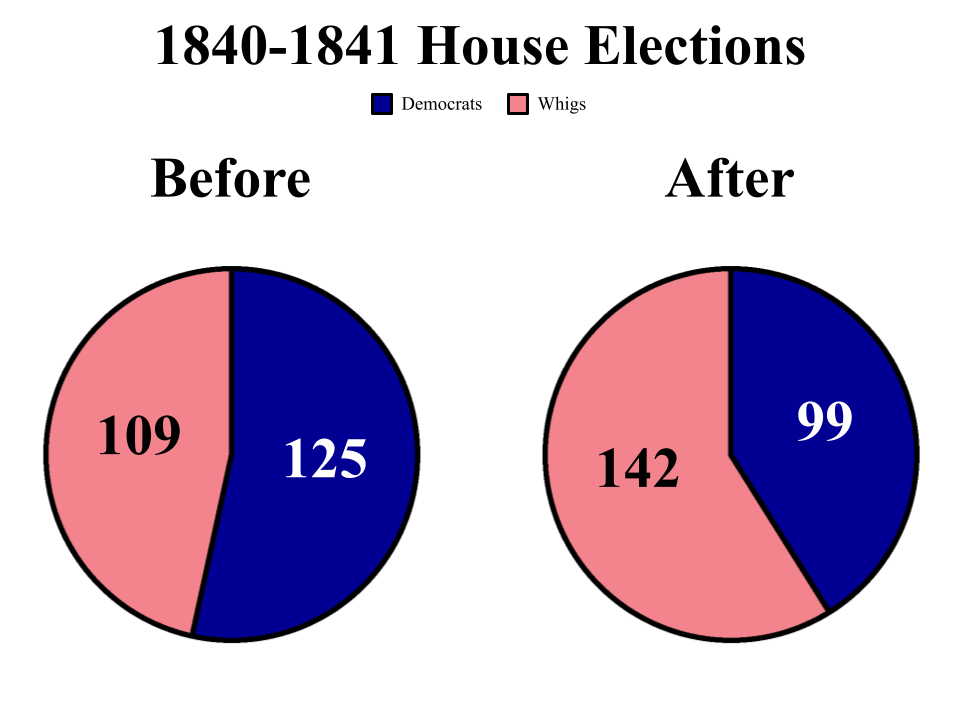
Not only did the Whigs get an impressive victory in the presidential election, they also did incredible in congressional elections, finally obtaining a majority of seats in the House of Representatives, and a pretty large one at that. After years of struggling against the Democrats, Fillmore finally found himself as part of the winning national party. With President Harrison, the Whigs could usher in a new era of economic prosperity.