 Part 10
Part 12
Part 10
Part 12
Most presidents end up seeking reelection after their first term. Being an incumbent tends to be an advantage in elections, since people trust the devil they know over the devil they don't. Yet pretty soon after he unexpectedly assumed office, Millard Fillmore determined that he didn't want to run for another term.
At first, he refused to openly say this, as he thought it may end up helping and encouraging enemies of the compromise. His decision was reflected in his actions, however. If he had planned on running again, he likely would have done more to further his influence through patronage.
In late 1850, he thought of finally making an announcement, but he was scared that if he directly announced his intentions, people would turn on him. So instead, he asked his friend Thomas Foote to spread rumors that he was withdrawing. No one believed the rumors, especially because Southern Whigs were very happy with Fillmore and likely would have rejected any other candidate. And even in the North, many still wanted him and shared his views on slavery. Weed was certain enough that Fillmore would win the nomination that he pessimistically took a trip to Europe.
To spectators, it seemed there were three candidates for nomination: Fillmore, Winfield Scott, and Daniel Webster.

Fillmore was most popular in the South. Webster was popular in New England, but many of his supporters also liked Fillmore. Seward was initially in the race, but in the end, his supporters moved toward Scott. Seward wanted to do whatever he could to stop Fillmore, even potentially tearing the Whig Party apart. His goal was to break the parties among regional lines, making the Whig Party the party of the North. That way, the Whigs could fully embrace anti slavery policies.

Ultimately, when Fillmore saw Webster wanted to run, he felt that Webster could continue where he left off, so he planned on announcing his withdrawal in his annual address to congress in December of 1851. But many urged him to reconsider. Factionalism was really bad within the Whig Party, and it seemed that without Fillmore, the party may actually collapse.

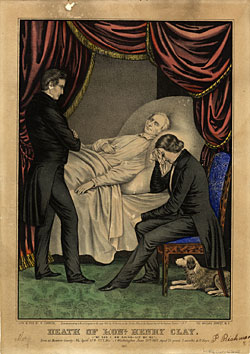
Henry Clay, now in his seventies, was nearing the end of his life. On his deathbed, he announced that he wanted Fillmore as the Whig nominee. Clay had once been one of Fillmore's rivals, but by this point things had changed so much that they suddenly appreciated each other, both key figures in the Compromise of 1850.
Once again, Fillmore postponed the announcement of his withdrawal. He began to realize that uniting his wing of the Whig Party with the more radical wing may not actually be possible. The Seward Whigs were relentless toward him. They misrepresented his life, making him out to be a traitor to America and to the Whigs. They argued that the Fugitive Slave Act was so evil that it was impossible to support him.
He knew the Whig Party probably didn't have much time left, but he also felt it had to stay together at least for the election of 1852. Otherwise, the Democrats would get an easy victory because there wouldn't be enough time for a new party to replace the Whigs.
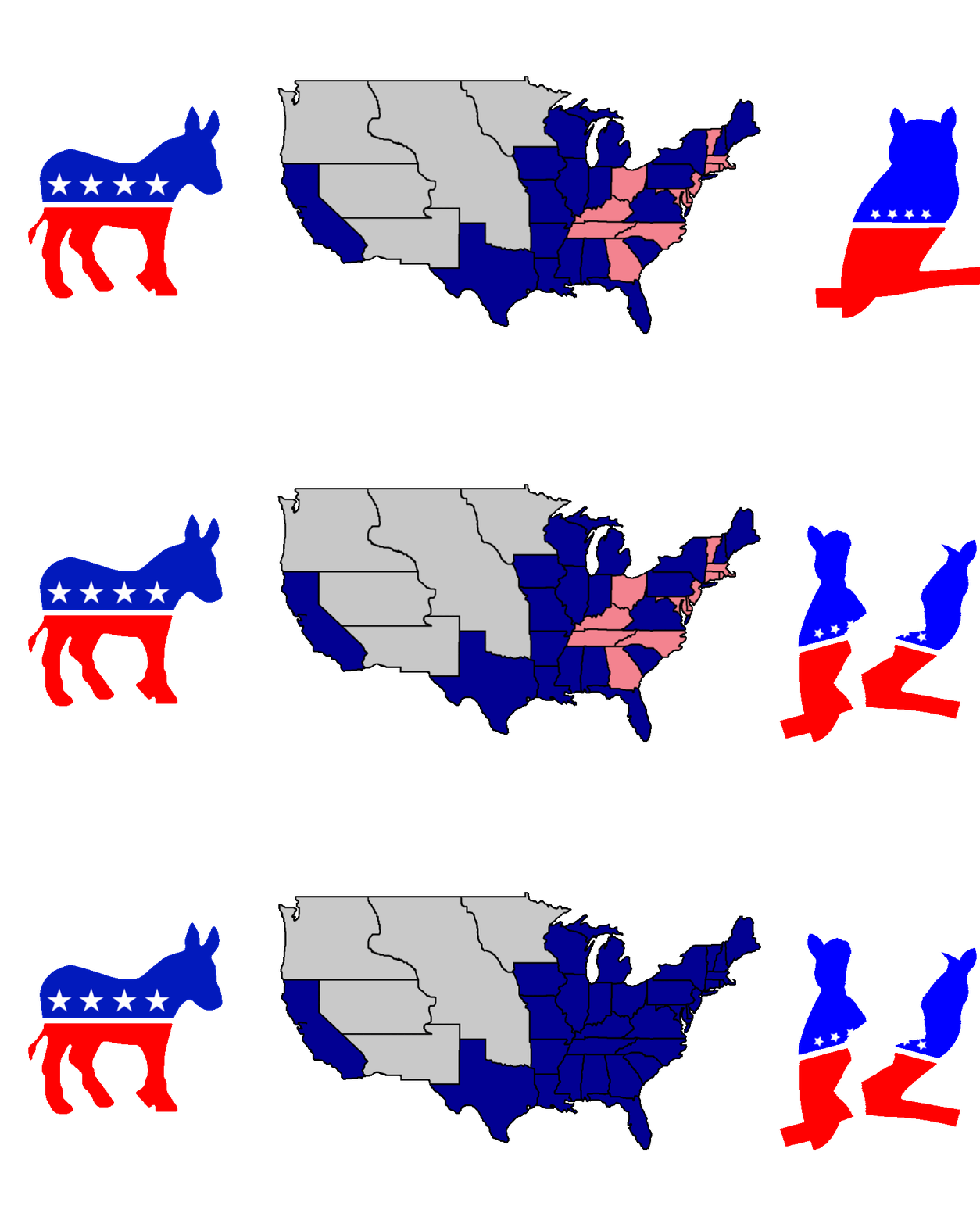
That left him with two choices. If he stayed in the race, he had a good chance of being the nominee, but would likely lose to Franklin Pierce, the Democratic candidate. Meanwhile, if he withdrew, the Sewardites would kick the moderate Whigs out of the party and cause the kind of sectionalism Fillmore was determined to stop. Since Webster's chances of winning were looking very low due to his poor health, Fillmore swallowed his pride and decided to run after all.
Then came the national Whig convention in Maryland, where the party's platform and presidential nominee would be decided on. When deciding a platform, the delegates endorsed the Compromise of 1850, a win for Fillmore. But choosing the nominee ended up being an absolute catastrophe.
Fillmore's past actions created a rough situation. Because he hadn't planned on running, he chose not to use his power for patronage, which ended up costing him a lot of delegates in the North. In addition, many were still uncertain if Fillmore even wanted another term in the first place, which also lost him some delegates. If he had just a little more Northern support, he could have won, but instead, no one got enough votes to win, so another vote happened. After a few votes, almost no one had changed their minds, and the convention adjourned.
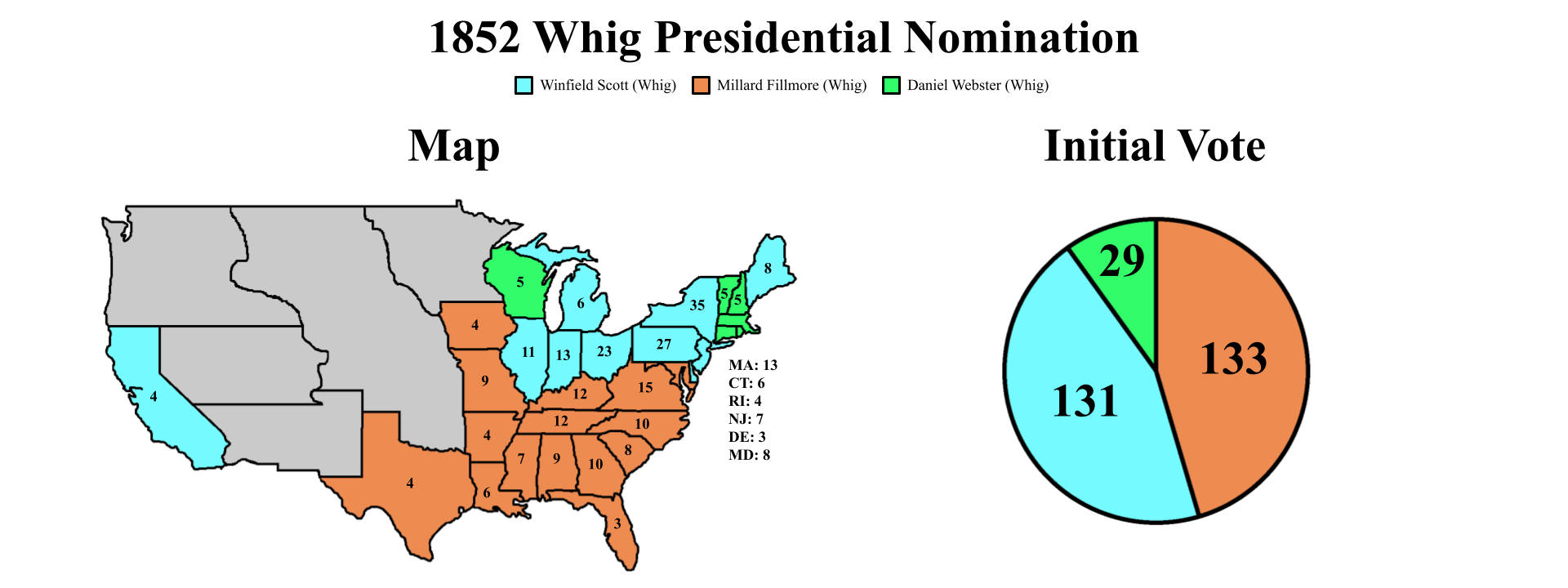
The next morning, they started voting again, and after more than three hours and 30 votes, nothing had happened. Then, after a break, the assembly met again and continued to achieve nothing. After the 46th vote, the convention adjourned and would meet again in a few days.
Things looked bad for Fillmore. Although it was obvious that Webster had no chance of winning, his supporters stuck by him, preventing Fillmore from obtaining a majority. In addition, Fillmore was slowly losing voters to Scott, with Scott's supporters assuring Southern delegates that Scott would not be a radical.
Since most Webster supporters favored Fillmore over Scott, someone went to Washington to urge Webster to withdraw. But Webster had been in politics for decades, and he wanted to be president to complete his legacy. He was very embarrassed that after so long, he could only get about thirty votes. He refused to withdraw, wanting to get a more respectable share of the vote.

Fillmore's friends met with Webster's and made a proposal: if Webster could reach 40 votes within the next two ballots, Fillmore's supporters would switch to supporting Webster. But if Webster could not reach 40 votes, Webster's supporters would switch to supporting Fillmore. Webster's managers accepted the first part of the proposal, but they said nothing about the second part.
When the next two votes finally happened in the morning, Webster failed to get 40 votes. Arguably, Webster's supporters should have switched to supporting Fillmore, but surprisingly, they shifted toward Scott instead. In addition, Fillmore was slowly losing voters to Scott.
By the 53rd vote, Scott finally reached a majority of the delegates and received the nomination. The Sewardites had officially won. Although the delegates had embraced the Compromise of 1850 in their platform, they also picked the preferred candidate of Seward, who hated the Compromise. This was a massive contradiction that only served to highlight how divided the Whigs were.

Despite this, Fillmore did not hold a grudge against Webster for staying in the race or for the fact that his supporters ended up supporting Scott. Webster felt like he had failed and thought about resigning his position as Secretary of State, but Fillmore told him not to. However, Scott's nomination made it clear that the Whig Party was effectively dead after the election of 1852. And in that election, Pierce obliterated Scott in the electoral vote.

After the election, Fillmore's presidency was finally coming to a close, and he began to worry about his life after the presidency. His main concern was that he could not go back to his modest house in Buffalo. As a retiring president, he felt it was not appropriate for him, so he asked Nathan Hall to find him a new house. Another concern was that he needed to find a new job. Hall encouraged him to go back to practicing law, and he agreed.
Finally, Fillmore planned on going on tour through the South after his presidency. But this trip fell through when his wife got sick. A few weeks later, she died. During his time as president, Fillmore's family was often the only thing that made him happy.
 Part 10
Part 12
Part 10
Part 12