 Part 5
Part 7
Part 5
Part 7
After utterly failing to become governor, Fillmore once again retired from public life and returned to Buffalo, enjoying time with his family. Since Henry Clay lost the 1844 election, James Polk was now the president, and Fillmore was extremely unhappy with his administration. But all he could do now was watch from the sidelines.
Polk did a lot to expand the nation, which included annexing Texas, something Fillmore opposed. Even worse, Polk undid the tariffs of 1842 that Fillmore had fought hard for a few years before. Polk also vetoed a program for river and harbor improvement in the Great Lakes. In fact, he generally opposed using any federal funds for internal improvements, which was something the Whigs were heavily in favor of.
At the time, Fillmore was especially annoyed because he felt like the North's interests were being overlooked in favor of the South's. Tons of money was being spent on a war that would likely end up helping the South get more slave states, expanding the power of slaveholders. Meanwhile, things the North wanted, like improved infrastructure, were being overlooked by Polk. It didn't have to be this way. The North had a much higher population, giving them more representation in the House of Representatives. The Northern states had enough electoral votes to win the presidency without any Southern support. It appeared that the North was submitting to the South even though it didn't have to.

Fillmore didn't like the direction the federal government was headed in, but he was also unhappy about the direction New York was going in. The New York Whigs had just lost a major election, and they were becoming increasingly divided. Many had blamed their recent struggles on Weed and Seward, arguing that Weed's unchecked power and poor decision making were hurting the party. Many argued that he shouldn't deserve so much influence. Although Fillmore had his fair share of problems with Weed, he wasn't one to hold a grudge. He saw Weed as an important and valuable member of the party, so he didn't want people to use Weed as a scapegoat.
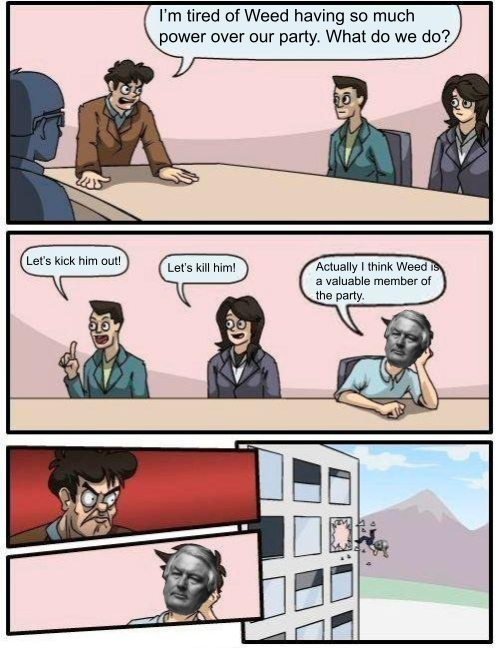
Still, despite Fillmore's sympathy, Weed couldn't avoid the fact that people had lost faith in him, and he couldn't always get his way anymore. In 1846, Weed pushed Ira Harris as their candidate for governor, but New York City Whigs disagreed, and John Young was nominated instead.
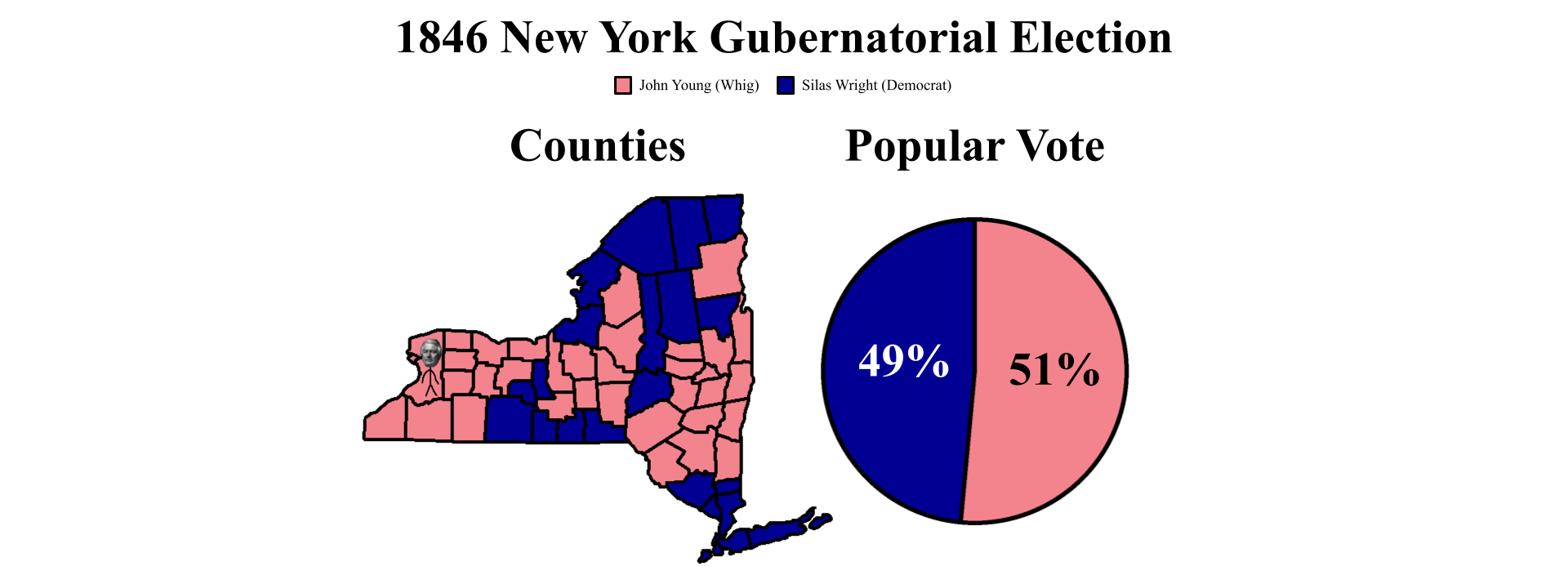
Not only did the Whigs take back the governorship, but they did so while actively disobeying Weed. This only furthered the feeling that the Whigs didn't need Weed and shouldn't let him control them so much. Weed was furious, hating the idea of sharing leadership, but there was nothing he could do.
Getting the governorship was already great, but there was more work to be done in 1847. Under New York's new constitution, several important offices that were previously appointed by the state legislature would now be decided by elections. In other words, several offices were still occupied by Democrats, and if the Whigs wanted full power over New York, they were gonna have to get those Democrats voted out of office. The most notable office up for grabs was the comptroller, a position that held more economic power than even the governor.
Although the Whigs had succeeded in 1846, the Democrats were working hard in preparation for 1847. The Whigs needed their best man to run for comptroller, and it would be stupid to argue that there was any candidate superior to Millard Fillmore. He was an extremely effective and intelligent leader, and he was not too radical in a way that would alienate anyone. Fillmore came out of retirement again to hopefully win the office.

Fillmore won, and with a very impressive margin of victory over his Democratic opponent. In fact, all of the Whig candidates won their respective elections, and they all did so decisively. Quite notably, Fillmore's margin of victory was the largest of all.
| Office | Whig Candidate | # of Whig Votes | # of Democratic Votes | Whig Margin of Victory |
|---|---|---|---|---|
| Lieutenant Governor | Hamilton Fish | 170,072 | 139,623 | 30,449 |
| Secretary of State | Christopher Morgan | 169,470 | 144,133 | 25,337 |
| Comptroller | Millard Fillmore | 174,756 | 136,027 | 38,729 |
| Attorney General | Ambrose Jordan | 174,763 | 139,481 | 35,282 |
| Treasurer | Alvah Hunt | 169,422 | 145,966 | 23,456 |
| State Engineer | Charles Stuart | 173,003 | 134,944 | 38,059 |
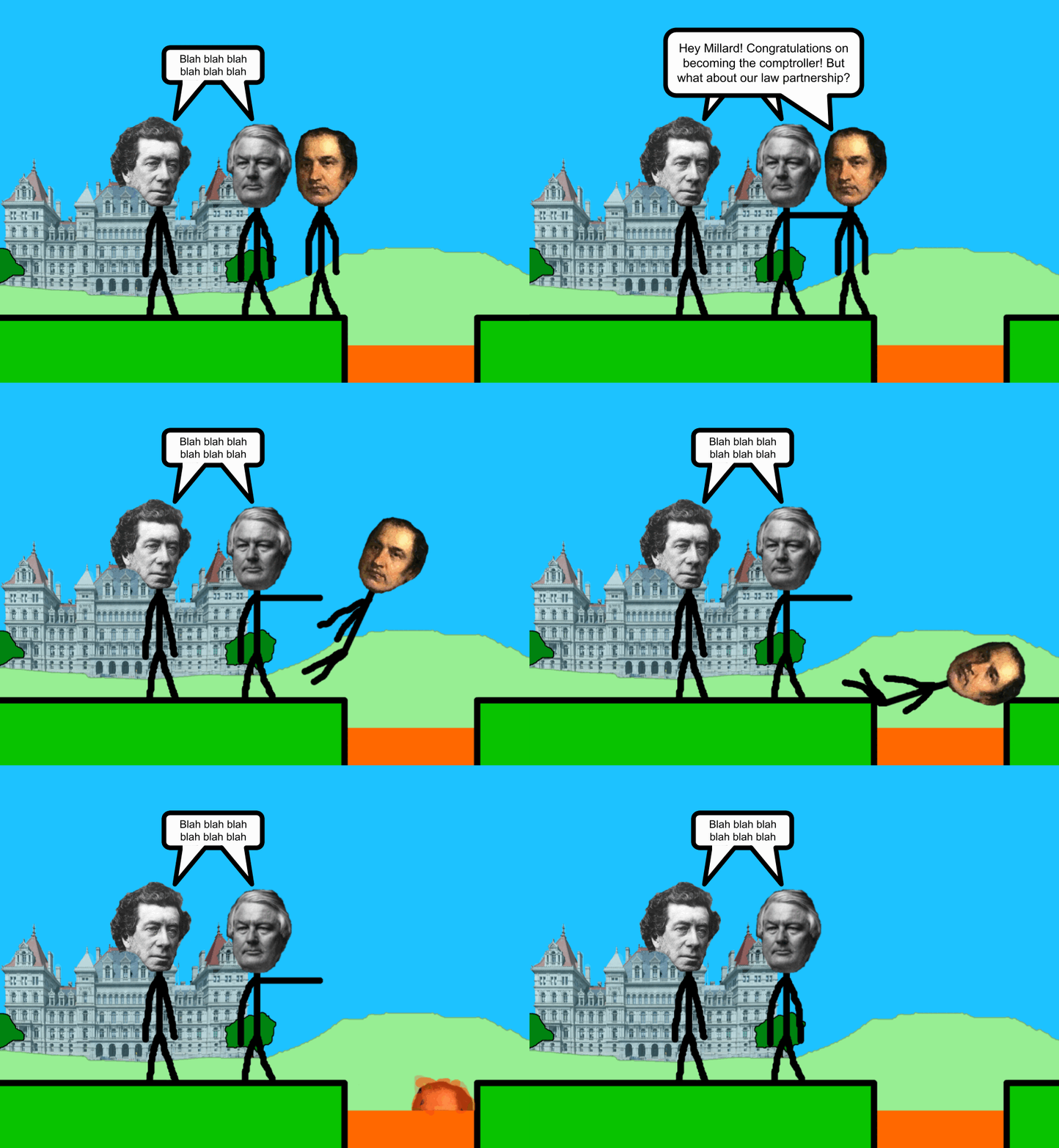
When he finally went to Albany for his new job, he realized that public life was his passion, and that he wanted to be involved in politics for the rest of his life. Practicing law was just not enough for him, so he decided to dissolve his law partnership with Solomon Haven and fully commit to politics.
The election of 1848 was approaching, and Polk wasn't running for reelection, giving the Whigs a good chance to take back the White House. But picking a candidate was gonna be difficult this time. The Whigs were becoming increasingly divided over slavery. Northern Whigs were experimenting with ways to win voters, and the slavery issue, once considered very risky and divisive, now seemed to have the potential to be a winning issue. John P. Hale, who was once shunned for associating with abolitionists, was suddenly elected to the United States Senate. In Pennsylvania, Whigs fully embraced anti-Southern sentiment.
Unfortunately, this was very alienating to the Southern wing of the party, since antislavery sentiment was never gonna be popular in the South. The debate over slavery ended up splitting the Whigs loosely into two groups. On the one hand, people like John Quincy Adams and Charles Sumner, both staunchly antislavery, started calling themselves the "Conscience Whigs". Meanwhile, they called Whigs who were sympathetic to slavery the "Cotton Whigs", which may be a reference to the fact that Southern cotton was frequently harvested with the use of slave labor.
All this rhetoric about slavery wasn't for nothing. It was an extremely important issue in the upcoming election. In the Mexican-American War, the United States won a huge amount of new territory, and this created an awkward question: should this new land allow or prohibit slavery?
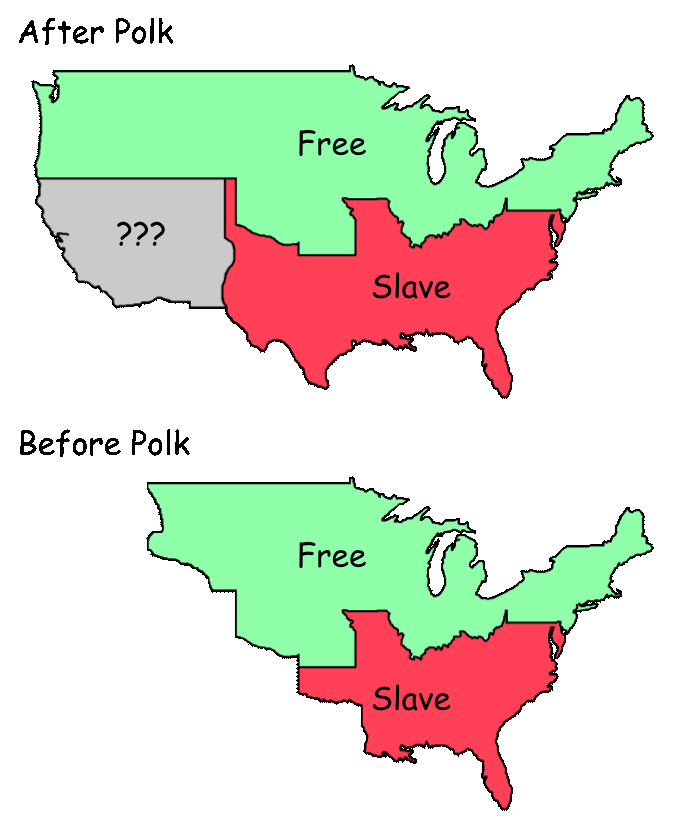
The South was very insistent on using the new land to admit as many new slave states as possible. That may seem kind of odd. After all, as long as slavery was legal in their states, why should they even care if it's legal in other states? But there's a reason the South placed so much importance on it. As previously stated, the North had a huge majority in the House of Representatives because of its higher population. However, in the Senate, there was an equal number of slave states and free states, meaning the South could avoid domination by the North. However, if this new land was used to admit a bunch of free states, the South would become a minority in both branches of the American congress, which would allow the North to easily pass laws restricting or even abolishing slavery.
While the South was desperate to add more slave states, the increasingly abolitionist North wanted to do the opposite. David Wilmot of Pennsylvania suggested that slavery should not be allowed in any newly acquired lands, a proposal which became known as the Wilmot Proviso. His measure passed in the House of Representatives, but not in the Senate, where the South had equal power with the North.
Southern Whigs saw Northern rhetoric surrounding the expansion of slavery, and they were very concerned. If the Whig Party fully embraced antislavery policies, it would die out in their region. Because of this, Southern Whigs thought their nominee for president in 1848 had to be a Southerner who could save the party in the South and encourage the North to settle down.
The Southern Whigs soon had an idea for a good candidate: Zachary Taylor, who was a general in the Mexican-American War. In the past, generals like Andrew Jackson or William Harrison had made for great presidential candidates, with many Americans seeing them as heroes regardless of their political views. Taylor was such a popular general that both the Democrats and the Whigs wanted him on their side, and since he was from Virginia, he was appealing to Southern Whigs.
The thing is, Taylor himself was not a very political person. He didn't identify with either party and had never even voted in a presidential election. He said that if he accepted a nomination, it would only be under the condition that he did not have to follow any party doctrine. Three months later, he revealed himself as a Whig, but he still didn't want to be restricted by partisan politics.
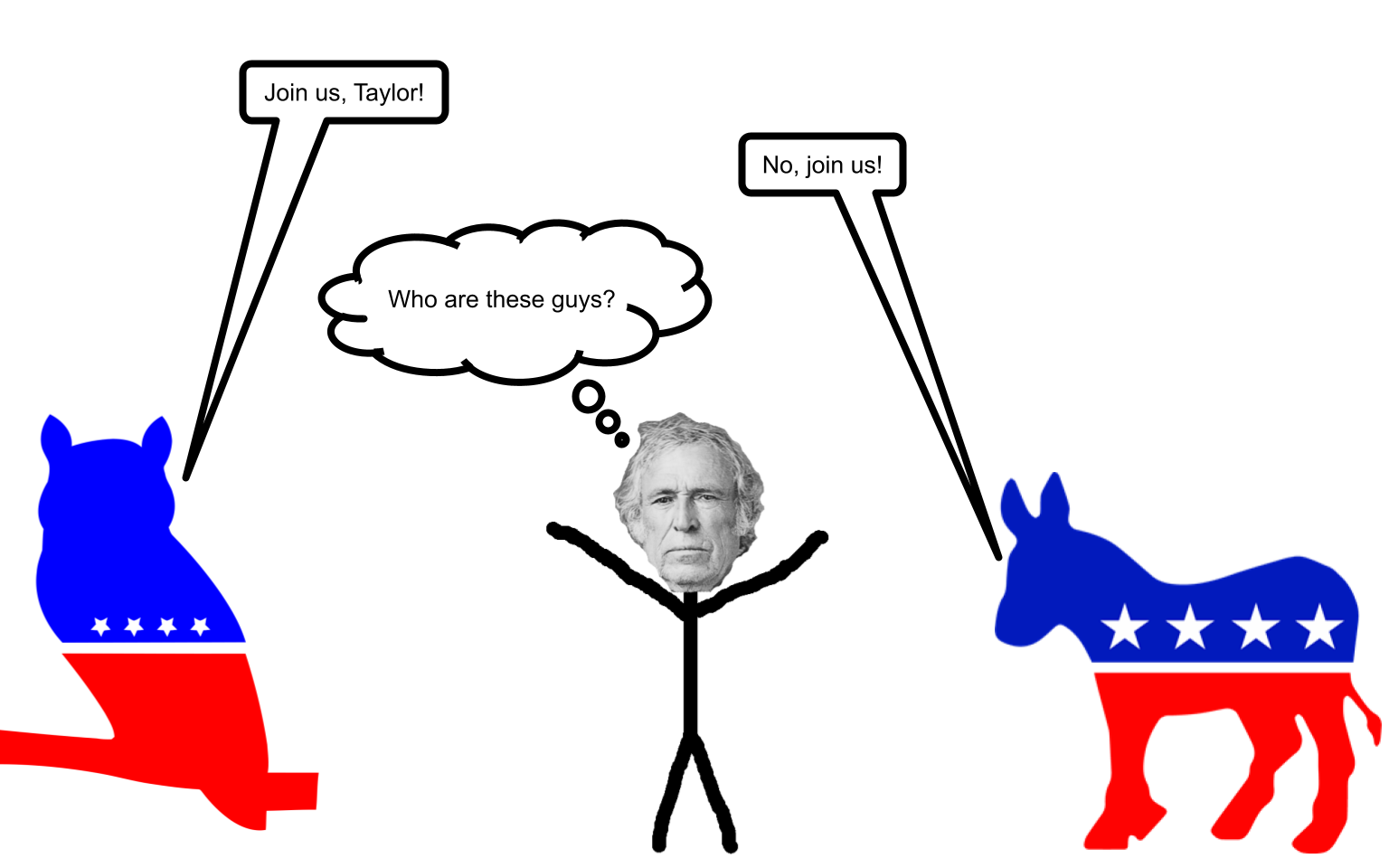
Even though he could barely be called a Whig, he was still popular anyway. However, Taylor was very controversial among Northern Whigs due to his weak stances and the fact that he was a slave owner. Because of this, many Northerners supported Henry Clay instead. When trying to get the nomination, Taylor's campaign was very strategic and deceitful in a way that would not work in the modern internet age. In areas where the Whigs were popular, he was marketed as a Whig. But in areas where the Whigs were not popular, he was marketed as nonpartisan. I don't really think you could do that today because word gets around much more quickly. What do you think? Could you do that today?
As for Fillmore's thoughts on this whole ordeal, he was actually perfectly fine with Taylor. He was angry with the South, but he only had problems with Southern Democrats, not Southern Whigs. Weed, on the other hand, was very unhappy with Taylor. Angry about his loss of influence in 1846, he wanted to use the election as a chance to regain power, so his goal was to get anyone other than Taylor as the Whig nominee. He also wanted to get a strong political position for Seward.
Taylor's managers knew he was controversial in the North, so they tried getting Northern support by supporting someone from New England as Taylor's running mate. However, they also wanted to make sure the person they picked was not antislavery. In the end, they chose Abbott Lawrence. Lawrence was very wealthy and involved in textile manufacturing, which naturally meant he associated with slaveholders (you need cotton for textiles, after all). Due to Lawrence's associations, many Conscience Whigs were pissed about the idea of him becoming the Vice President, especially because Zachary Taylor was already a Southern slave owner.
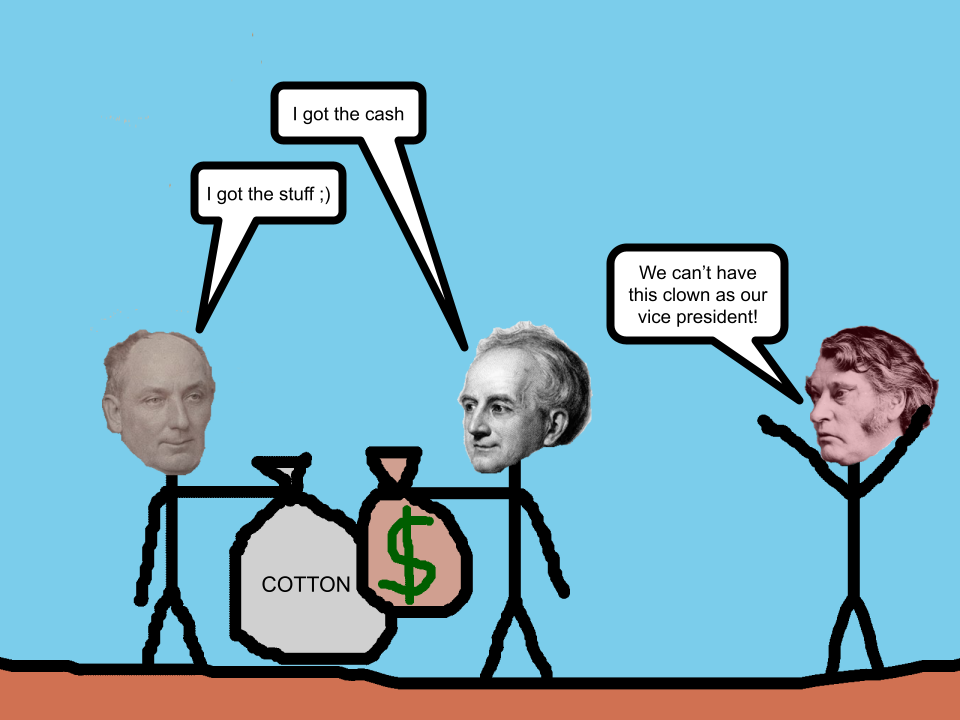
But despite what others were saying, Weed felt differently about Lawrence. Weed thought that if he endorsed Lawrence for Vice President, he could use him to influence Taylor. Therefore, even if Weed didn't get his way and Taylor ended up as their nominee for President, he still had an opportunity at regaining power. Fillmore also supported Lawrence for the sake of party unity. Some wanted him to try to get the nomination himself again, but he decided not to go for it this time.
Though many Northerners preferred Clay, Taylor seemed to be on his way to victory. At the 1848 National Whig Convention, John Collier suggested a surprising compromise: To appease Northerners who wanted Clay for President, they should nominate Millard Fillmore for Vice President. Even though Millard Fillmore didn't even like Clay, this plan worked. Zachary Taylor got the nomination for President, and Millard Fillmore, despite his prior refusal to run, suddenly found himself as the Whig Vice Presidential candidate.

With all that said, Fillmore's new position put him under a lot of scrutiny. While Taylor had gotten a lot of bad press for being too proslavery in the North, Fillmore got painted as a radical abolitionist by Southern Democrats. In reality, Fillmore's views on the issue were far more complicated. Though he was personally opposed to slavery and considered it morally evil, he didn't think the national government had the right to abolish it in the states it was legal in. However, this didn't stop any of the attacks on him in the South.
Meanwhile, Fillmore also had to deal with drama at home. Weed was unhappy with Taylor's nomination, and when he saw that it was Fillmore, not Lawrence, who was nominated for Vice President, he was even more upset. He wanted to get the New York Whigs to completely reject Taylor. The Whig electors for New York would be chosen at a state convention, so Weed wanted to choose electors who would refuse to cast their votes for Taylor. He even called for a mass meeting of Whigs to discuss how to deal with Taylor.
Fillmore, unsurprisingly, was very opposed to Weed trying to hurt his running mate, and he argued with Weed about whether or not the meeting should happen. In the end, Fillmore wasn't able to deter Weed from holding the meeting, but he did convince him to tone it down, focusing on trying to guide Taylor in a better direction rather than abandoning him entirely.
When the meeting was finally held, it actually ended up being largely pro-Taylor. In addition, Fillmore and Weed wrote a letter to Taylor giving him advice on how to make himself more appealing to the Whigs. Taylor accepted this advice, and in a letter to his brother-in-law that was made public, he clarified his stances. He said that he would not veto anything passed by congress unless it was unconstitutional. This got more Whigs on Taylor's side, since it meant Taylor wouldn't oppose their policies like higher tariffs or internal improvements, even if he wasn't an enthusiastic supporter of them. Thus, Fillmore was able to hold the New York Whigs together.

This election cycle, there was a new political party that posed a threat in the North: the Free Soil Party. The Free Soil Party was an antislavery party that was opposed to the expansion of slavery. They took votes away from both parties, but it's likely they did more to hurt the Democrats.
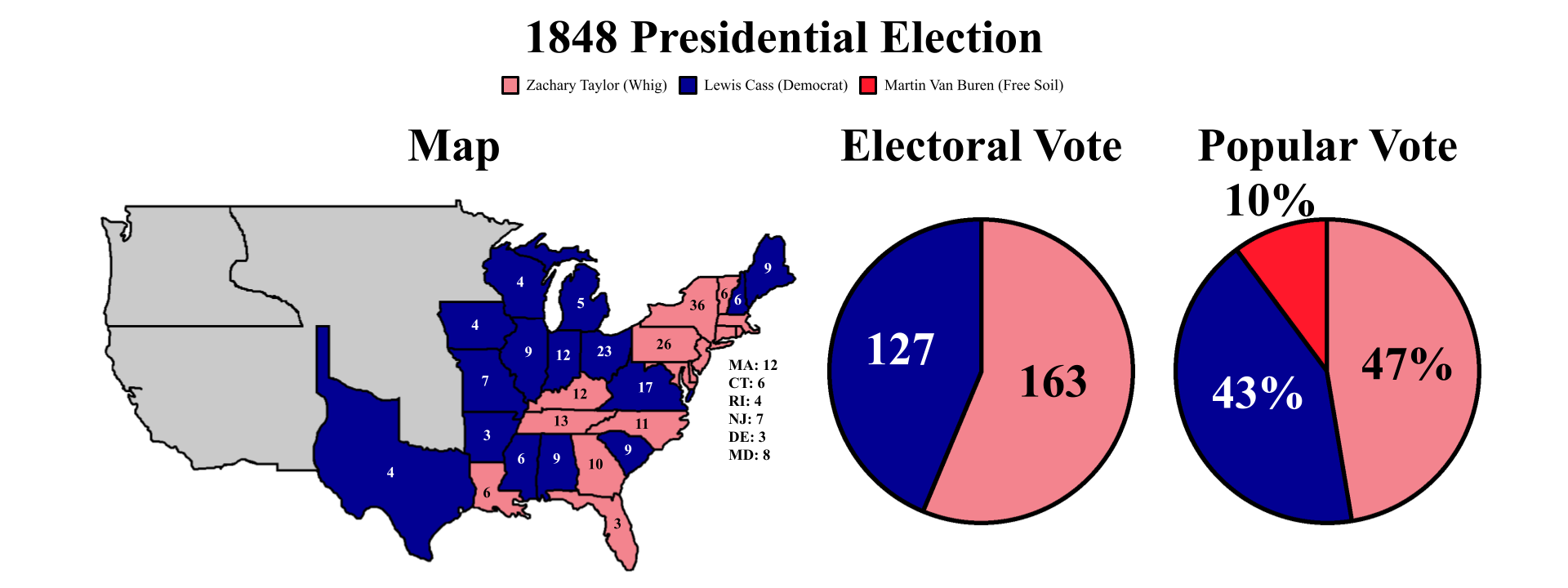
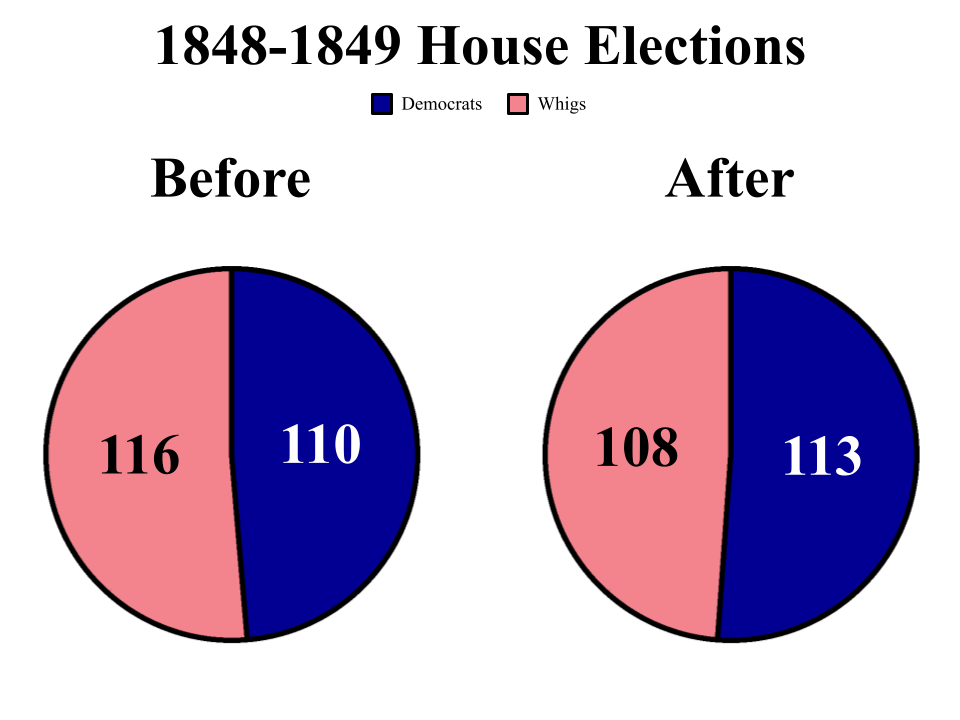
Taylor narrowly won the election, and without New York, he would have lost. In House elections, the Whigs ended up being on roughly equal footing with the Democrats. In the Senate, the Democrats had a clear majority. With Taylor not being much of a Whig and with the Whigs not having a majority in congress, it was not the best outcome for them, but not the worst either.
But none of that really matters. What really matters is that Millard Fillmore was now the Vice President! But like all Whig presidents, Taylor did not serve for a full term.
Part 5 Part 7